Men’s Bracketology 1/31/2026
I moved Michigan up to my #1 overall seed after their huge wins over Nebraska and Michigan State this week. The win over Michigan State knocked the Spartans down to the 3 line, Iowa State took their spot as a 2.
I’ll be back on Monday with a huge update, almost every bubble team is in action this weekend.
1: Michigan, Arizona, Duke, Connecticut
2: Nebraska, Houston, Illinois, Iowa State
3: Gonzaga, Michigan State, Purdue, Vanderbilt
4: BYU, Texas Tech, Kansas, Florida
5: Virginia, Alabama, Arkansas, Tennessee
6: St. John’s, Auburn, Clemson, North Carolina
7: Louisville, Iowa, Saint Louis, Villanova
8: UCF, Utah State, SMU, St. Mary’s
9: Georgia, Texas A&M, NC State, Kentucky
10: Miami (FL), UCLA, New Mexico, Wisconsin
11: Ohio State, (Indiana/USC), (San Diego State/Santa Clara), Miami (OH)
12: Belmont, Tulsa, Liberty, Yale
13: McNeese, High Point. Hawai’i, Utah Valley
14: Oakland, Troy, UNC Wilmington, East Tennessee State
15: North Dakota State, Portland State, Lipscomb, Siena
16: Navy, UT-Martin, (LIU/Bethune-Cookman), (Vermont/Howard)
First Four Out: Texas, Virginia Tech, Seton Hall, George Mason
Next Four Out: TCU, VCU, California, Nevada
Also Considered: Missouri, Oklahoma State, West Virginia, Washington, Butler, LSU, Akron, Grand Canyon, Creighton, Baylor, Stanford
Moving In: Navy, Siena
Moving Out: Colgate, Marist
Bids by Conference:
Big 10: 11
SEC: 9
ACC: 8
Big 12: 7
Big East: 3
Mountain West: 3
West Coast: 3
Men’s Bracketology 1/29/2026
Teams that are currently in my field had a good few days as most of them won (UCLA, New Mexico, Wisconsin). Teams that were outside the field mostly lost (Texas, TCU, Baylor). That means that the gap between those in the field and those outside the field grew significantly.
I feel quite good about my first 38 teams making the tournament (so UCLA on up). The gap between UCLA and the Seton Halls and TCUs of the world is getting quite large.
I’ll be back with another update on Saturday morning. The main thing to watch between now and then is the huge Michigan/Michigan State game that will go a long way to determining the 1 seed race.
1: Arizona, Michigan, Duke, Connecticut
2: Nebraska, Houston, Illinois, Michigan State
3: Iowa State, Gonzaga, Purdue, Vanderbilt
4: BYU, Texas Tech, Kansas, Florida
5: Virginia, Alabama, Arkansas, Tennessee
6: St. John’s, Auburn, Clemson, North Carolina
7: Louisville, Iowa, Saint Louis, Villanova
8: UCF, Utah State, SMU, St. Mary’s
9: Georgia, Texas A&M, NC State, Kentucky
10: Miami (FL), UCLA, New Mexico, Wisconsin
11: Ohio State, (Indiana/USC), (San Diego State/Santa Clara), Miami (OH)
12: Belmont, Tulsa, Liberty, Yale
13: McNeese, High Point. Hawai’i, Utah Valley
14: Oakland, Troy, UNC Wilmington, East Tennessee State
15: North Dakota State, Marist, Portland State, Lipscomb
16: Colgate, UT-Martin, (LIU/Bethune-Cookman), (Vermont/Howard)
First Four Out: Texas, Virginia Tech, Seton Hall, George Mason
Next Four Out: TCU, VCU, California, Nevada
Moving In: None
Moving Out: None
Bids by Conference:
Big 10: 11
SEC: 9
ACC: 8
Big 12: 7
Big East: 3
Mountain West: 3
West Coast: 3
Bracketology Bets 1/28/2026
I was very excited to see this morning that DraftKings and FanDuel have listed odds on various teams to make/miss the NCAA tournament. I’ve been waiting for these to pop up for a few weeks now. I made quite a bit betting these lines last year, they’re pretty soft and my knowledge of bracketology is obviously a huge help.
I’ll post picks as I make them here on my website over the next several weeks. I will warn my readers that last year a lot of these opportunities came and went quickly- and some of the best opportunities I saw all season were in the minutes leading into the selection show. So keep your eyes on this space for more picks over the course of the weeks to come.
Texas to miss tournament +310 (4 units)
I don’t get this line. Texas is right on the cut line right now- a resume average of 57 and predictive average of 38 is a classic bubble team. My model thinks they’ll probably make the field at 19-12, are a coin flip to make the field at 18-13, and are pretty unlikely to make it at 17-14. Both KenPom and T-Rank project them for 18-13. This is my favorite line I saw and it’s not close.
USC to make tournament +154 (1 unit)
USC would make the field if it was selected today but their predictive metrics are worse than their resume metrics. This indicates that their position is more likely to worsen than improve over the next two months. However, their predictive metrics aren’t that bad- they’re 50th in Kenpom. 20-11 will get the job done, 19-12 might, and Kenpom projects them for 20-11.
LSU to make tournament +450 (1 unit)
LSU has lost six of seven to fall from in the tournament to out. They’re definitely out of the field if it was selected today, but they have 11 games to make up ground, and 7 of them are against Q1 opposition. Their predictive metrics are all in the mid-40s, which is solid for bubble teams- they definitely can win these Q1 games on their schedule. 20-11 will definitely get them in and 19-12 might.
West Virginia to miss tournament -440 (1 unit)
I think West Virginia’s tournament chances are pretty dead. Their metrics are mostly in the low 60s, which is not close to the field. Their NCSOS is really bad, which means they’re going to have to go on a tear down the stretch to get in. I think they need to go 21-10 to get in, and Kenpom and T-Rank both have them projected at 19-12.
Men’s Bracketology 1/26/26
The wheat separated from the chaff this weekend. Several teams who were pretty likely to make the tournament took big steps towards firming up their bid. Auburn, UCF, UCLA and USC are some examples- all played games that we’re lose-able, but all won easily. That’s bad news for the few bubble teams who lost, like Seton Hall who fell to DePaul.
At the top of the bracket, my 2 line is entirely composed of Big Ten teams after Illinois’ road win over Purdue. I also have Michigan on the 1 line. The Big Ten is not going to be able to maintain 5 teams on the top 2 seed lines- there’s just not enough wins in the league to go around. The winner of Tuesday’s Nebraska/Michigan game will be solidly on my 1 line on Wednesday’s update.
I’m sure I’m one of the very few bracketologists who have Indiana in. This is mostly a philosophy difference- they’d be out if the field was seeded right now. However, their predictive average is 29.3- indicating they will probably do enough down the stretch to earn a bid. I think 19-12 should get them there.
I’d also like to shout out Santa Clara, who I moved into my bracket today, I believe for the first time in my 16 year history of bracketology. The Broncos are in very few projected brackets right now, but I’m not sure why- their resume average is 50.3 and their predictive average is 47.
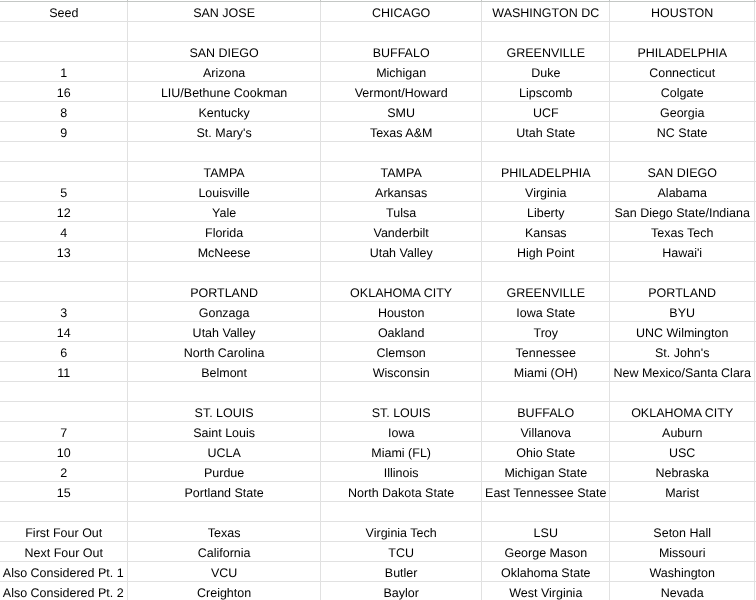
Moving In: Indiana, Santa Clara
Moving Out: Seton Hall, Virginia Tech
Bids by Conference:
Big 10: 11
SEC: 9
ACC: 8
Big 12: 7
Big East: 3
Mountain West: 3
West Coast: 3
MSU Basketball Mid-Season Report Card
I don’t talk much about the teams that I’m actually a fan of on here. However, much to my surprise, my Michigan State Spartans look like a FInal Four contender this year. Thus, I figured it was worth taking a stab at creating a mid-season report card for each player and the team as a whole.
First, a word on my scoring system. Instead of a traditional score (A, B, C, D etc.), I’m using a numerical scoring system. A 3 means someone has performed in-line with my expectations, a 2 means they’ve performed significantly better, and a 4 means they’ve performed significantly worse. 1 is the best possible score but is quite rare, 5 is the worst possible score and is also quite rare.
Overall Team Score: 2
We’re nearly halfway through Big Ten play, and the Spartans are on track for a 2 seed. They got a 2 seed last year, but I expected this year’s team to be worse with Jase Richardson and Jaden Akins off to the NBA. I have been pleasantly surprised by the 18-2 start, and any reasonable fan would agree with me. Most computer systems had us in the 20s in the preseason.
The team is built on the boards. We get an offensive rebound on 39% of our missed shots (8th in the nation) and get a defensive rebound on 78% of our opponent’s missed shots (1st in the nation). We’re not a great shooting team, but we attempt far more shots than our opponents because we dominate on the glass.
I considered a 1.5 for the overall team score, but our lack of perimeter shooting limits the team’s upside.
Jeremy Fears Jr.: 1.5
It goes without saying that Fears has been the best player on the team and the biggest reason for our outperformance. He’s not the best point guard we’ve had in the last twenty years (that’s Cassius Winston), but he is the best pure passer. Not only are his assist numbers off the charts, but the way he runs the fast break is unmatched. The team has dominated in transition all year and it’s because of his court vision.
I see upside in his shot. He has been excellent from the free throw line (89% this year on decent volume), it’s a bit weird he’s only shooting 29% from 3 given how consistent he is at the stripe. He has gotten more comfortable pulling up from mid range when defenses sag off him, he’s 18/32 from mid range since the new year. If he starts shooting like Tyson Walker or Cassius Winston did, watch out.
Coen Carr: 3.5
This might be a controversial score. Coen Carr has certainly been good this year, but I expected more. The highlights are obvious- he can jump out of the building and is the best dunker I’ve ever seen in green and white. He also plays bigger than his size and is a good rebounder.
However, the downsides are pretty bad. He’s 50/87 (58%) from the stripe, 12/40 (30%) from midrange and 11/41 (27%) from 3. All of these numbers are worse than last year. It pains me to say, but he’s a liability in the half court offense.
If he can develop a shot, he has a long NBA career ahead of him. He’s still a good college player even if he never learns to shoot. The good news is that shooting is easier to teach than a 51 inch vertical.
Jaxon Kohler: 1.5
Izzo has bucked the trend by developing high school players instead of building through the portal. Jaxon Kohler is the most recent success story of that model. He was a mediocre rotation player for his first two years in East Lansing and has blossomed into an excellent power forward. He is a monster on the offensive glass.
If you look at the list of D1 players with the most offensive rebounders, Kohler sticks out like a sore thumb. Most of the guys on that list have taken fewer than 10 3s this year. Kohler has taken 73, and made 47% of them. There’s just not another player like him in college basketball.
Carson Cooper: 2
Cooper is the other developmental success Izzo can hang his hat on. He’s always been good on the glass, but he has added the 8 to 10 foot range to his game this year. He also runs the floor better than pretty much any 6’11” player you’ll see, and gets a ton of dunks and layups in transition as a result. This has been a very solid senior year for Cooper.
Kur Teng: 3
Teng played very limited minutes last year as a freshman, despite a decent recruiting pedigree. His development is on course with my expectations- he is a good perimeter shooter, probably the best we have. However, there’s nothing in his game beyond the 3 point shot. That’s not a problem this year, we just need him to play 15 minutes a game or so at the 2 guard. The next step in his game will be getting to the rim.
Divine Ugochukwu: 2.5
I need to eat my words on Ugochukwu. I was very skeptical when Izzo signed him out of the portal. Early in the season, I was calling for him to be removed from the rotation. He is not as good a shooter as Teng, but he has more to his game in terms of getting downhill. I expect the 2 guard to be a clean timeshare between him and Teng for the rest of the season.
Jordan Scott: 2
Scott is still a freshman, but the sky is the limit for his development in the next few years. He has the bones of an NBA skillset- is a decent offensive rebounder, a decent shooter and has good length. If those skills continue to develop, I would be surprised if he ends up spending 4 years in college. He also hustles his ass off, he seems to be on every single loose ball. I’m quite happy with what I see from him in year one.
Cam Ward: 2.5
Izzo seems to like to play his two main freshmen (Scott and Ward) together. I don’t mind, as they are pretty different players despite being similar heights- Scott is a wing, and Ward is a 4. He is fantastic on the offensive glass and is getting back in the rhythm of things after injuring his wrist several weeks ago. I am a bit worried by what I see at the free throw line, but the sample size is admittedly small.
Trey Fort: 4
I expected more from Fort this year. The team’s biggest weakness is the lack of outside shooting, and we brought in two transfers to try to fix that. Kaleb Glenn has been out for the year with an injury, and Fort has regressed from a 38% shooter at Samford last year (on good volume, too) to a 30% shooter this year. Of all the options we have at the 2 guard, he’s also the least athletic and the worst defender.
Jesse McCulloch: 2.5
McCulloch is an intriguing project. The freshman hasn’t played much, but when he has, he’s been a solid backup big. We’re so blessed with Cooper and Kohler that we haven’t asked very much of McCulloch, but when we have, he’s delivered. The sample size is small, but he also looks like a good shooter for 6’10”.
Denham Wojcik: 4.5
Wojcik is a transfer from Harvard and the son of assistant coach Doug Wojcik. He was not a particularly interesting Ivy League player at Harvard and I am pretty surprised he is still in the rotation. The offense looks stuck in the mud when he is at PG. Wojcik only plays when Fears needs a breather, but I’d rather Ugochukwu get those minutes. Ugochukwu was a pure PG last year at Miami and can handle the point OK.
Men’s Bracketology 1/24/2026
Pretty quiet two days on the bracketology front with few power conference teams in action. I will say that it’s snuck up on me how good of a profile Saint Louis has, they demolished St. Bonaventure last night. The Bilikens’ only loss this year is a buzzer beater to Stanford. Kenpom gives them a 15% chance of winning out, which could put them into the protected seed range.
1: Arizona, Michigan, Duke, Connecticut
2: Purdue, Nebraska, Houston, Michigan State
3: Iowa State, Illinois, BYU, Gonzaga
4: Vanderbilt, Florida, Virginia, Texas Tech
5: Alabama, Kansas, Arkansas, Louisville
6: Georgia, Clemson, Iowa, St. John’s
7: Villanova, Saint Louis, Tennessee, Kentucky
8: SMU, Utah State, St. Mary’s, Wisconsin
9: North Carolina, UCF, Auburn, Texas A&M
10: Miami (FL), Ohio State, NC State, UCLA
11: USC, (New Mexico/Seton Hall), (San Diego State/Virginia Tech), Miami (OH)
12: Belmont, Tulsa, Yale, McNeese
13: Utah Valley, High Point. Liberty, Hawai’i
14: Hofstra, Oakland, Troy, East Tennessee State
15: North Dakota State, Marist, Portland State, Queens
16: Colgate, UT-Martin, (LIU/Bethune-Cookman), (Vermont/Howard)
First Four Out: Santa Clara, George Mason, Baylor, Indiana
Next Four Out: LSU, Texas, TCU, Missouri
Moving In: None
Moving Out: None
Bids by Conference:
Big 10: 10
SEC: 9
ACC: 9
Big 12: 7
Big East: 4
Mountain West: 3
West Coast: 2
Men’s Bracketology 1/22/2026
The Mountain West is falling apart. Utah State looked very comfortable for an at-large but has dropped back to back games, including a Q3 loss at home to UNLV. San Diego State dropped a tight one on the road at Grand Canyon, which is more forgivable, but still does not help the league’s chances of multiple bids.
Purdue falls off the 1 line after a tight loss on the road to UCLA. The Boilermakers still have a 1-seed quality resume, we just have six such resumes right now and only four spots. That result also lets UCLA jump back into the bracket.
1: Arizona, Michigan, Duke, Connecticut
2: Purdue, Nebraska, Houston, Michigan State
3: Iowa State, Illinois, BYU, Gonzaga
4: Vanderbilt, Florida, Virginia, Texas Tech
5: Alabama, Kansas, Arkansas, Louisville
6: Georgia, Clemson, Iowa, St. John’s
7: Villanova, Tennessee, Kentucky, SMU
8: Saint Louis, St. Mary’s, North Carolina, Utah State
9: UCF, Auburn, Texas A&M, Wisconsin
10: Ohio State, Miami (FL), NC State, UCLA
11: USC, (New Mexico/Seton Hall), (San Diego State/Virginia Tech), Miami (OH)
12: Belmont, Tulsa, Yale, McNeese
13: Utah Valley, High Point. Liberty, Hawai’i
14: Hofstra, Oakland, Troy, East Tennessee State
15: North Dakota State, Marist, Portland State, Queens
16: Colgate, UT-Martin, (LIU/Bethune-Cookman), (Vermont/Howard)
First Four Out: Santa Clara, George Mason, Baylor, LSU
Next Four Out: Indiana, Texas, TCU, Missouri
Moving In: UCLA, Virginia Tech
Moving Out: Baylor, Indiana
Men’s Bracketology 1/20/2026
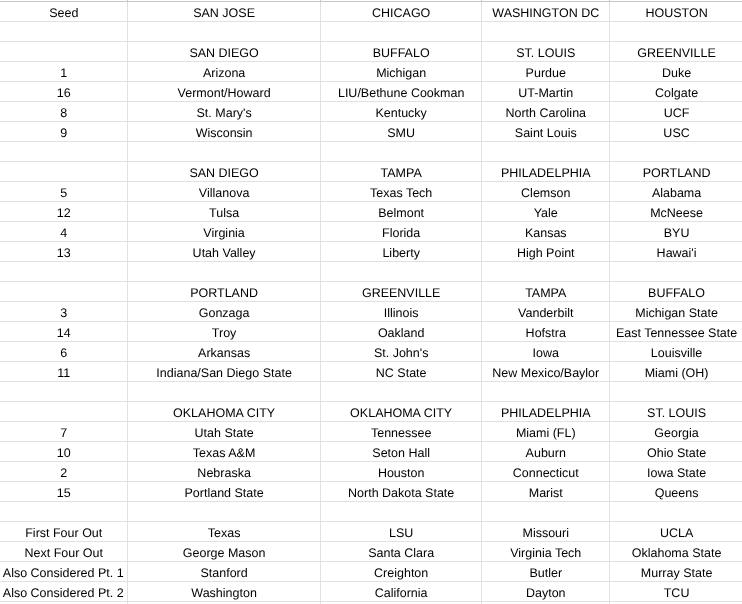
Saturdays in college hoops are like drinking through a firehose this time of year. Tons of important results happened up and down the seed list, but here’s a few that particularly caught my eye:
-Florida won at Vanderbilt. The Gators were the victims of some close losses early in the season, their resume is now inching closer to their top 10 predictive metrics. Vanderbilt, meanwhile, is out of the 1 seed conversation.
-Santa Clara beat St. Mary’s. Santa Clara’s at-large hopes are very much alive- the Broncos have not made the NCAA tournament in my lifetime, but an 8-2 finish should get them there.
-NC State lost at home to Georgia Tech. My model still has them in the field, which I reckon most people won’t. Certainly if the tournament started today they’d be well out of the field, but they’re still 30th in Kenpom and have 7 Q1 opportunities remaining. I think they will win enough of those to sneak their way back in, but it’ll be close.
Men’s Bracketology 1/15/2026
I’m trying a bit of a new approach with this seed list. My logic goes something like the following:
-Take every team’s current resume metrics
-Use their predictive metrics to estimate what’s going to happen the rest of the season
-Combine their current resume with their predicted resume from the rest of the season to estimate their final resume
-Rank teams based on their expected final resume
I built a crude model for this over the past few days, and these are the initial results.
I would say that this passes the smell test pretty well. Teams with big discrepancies between their resume and their predictives (Indiana, NC State, UCF) are generally placed somewhere between the two, which seems reasonable to me.
I would like to briefly shout out Texas who has picked up 2 Q1-A wins in 2 games, winning at Alabama and vs. Vanderbilt. The Longhorns were nowhere near the field a week ago and now are one of my last teams in.
1: Arizona, Michigan, Connecticut, Purdue
2: Duke, Iowa State, Houston, Vanderbilt
3: Nebraska, BYU, Gonzaga, Illinois
4: Michigan State, Virginia, Florida, Kansas
5: Alabama, Texas Tech, Villanova, Clemson
6: Utah State, Arkansas, Tennessee, Miami (FL)
7: Louisville, St. Mary’s, St. John’s, North Carolina
8: Iowa, UCF, Georgia, SMU
9: Seton Hall, NC State, Saint Louis, USC
10: Kentucky, Wisconsin, Auburn, Indiana
11: New Mexico, (Baylor/Texas), (Ohio State/Missouri), Miami (OH)
12: Belmont, Yale, McNeese, South Florida
13: High Point, Liberty, Hawai’i, Utah Valley
14: Hofstra, East Tennessee State, St. Thomas, Troy
15: Wright State, Portland State, Quinnipiac, Navy
16: Austin Peay, UT-Martin, (Vermont/Bethune-Cookman), (LIU/Norfolk State)
First Four Out: Texas A&M, UCLA, San Diego State, LSU
Next Four Out: Stanford, Creighton, George Mason, Virginia Tech
In the Hunt: TCU, Washington, Santa Clara, Oklahoma State, Syracuse, VCU
On the Radar Screen: Murray State, Dayton, Oklahoma, Butler, Nevada, California
Moving In: Kentucky, Baylor, Texas, Missouri
Moving Out: LSU, UCLA, Oklahoma State, Texas A&M
Men’s Bracketology 1/12/2026
We have a shakeup at the top of the bracket, as Vanderbilt rises to the 1 line, taking Michigan’s place. Michigan drops from the number 1 oveall seed to a 2 seed, but it’s a very competitive race at the top of the bracket. We still have 11 power conference teams with 0 or 1 losses, which is quite a lot for this time of the year.
On the bubble, Michigan’s loss is Wisconsin’s gain. You won’t see many better wins in college hoops all season than the Badgers’ road win in Ann Arbor. It vaults them from the next four out to comfortably in the bracket as a 10 seed.
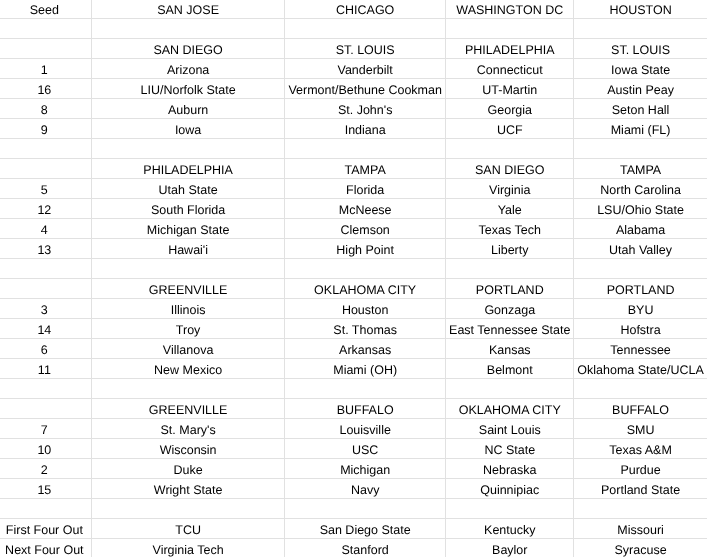
Moving In: Oklahoma State, UCLA, Wisconsin
Moving Out: TCU, Missouri, Stanford
Bids by Conference:
Big 10: 11
SEC: 9
ACC: 8
Big 12: 8
Big East: 4
Mountain West: 2
West Coast: 2
Men’s Bracketology 1/10/2026
I seriously considered moving Vanderbilt to the 1 line in this update- I do truly feel that we have 5 1-seed quality resumes at this point in the season. Ultimately we still have 4 undefeated power conference teams and 1 extremely impressive 1-loss resume (Connecticut). I could see UConn getting passed up in a few weeks though, simply because they don’t have as many quality win opportunities in the Big East as say, Iowa State and Vanderbilt might.
On the bubble, I’ve dropped Kentucky from the field. I thought other bracketologists were a bit rash for doing this a few weeks ago- the Wildcats’ predictive metrics were still in the 20s. However, after a disastrous home loss to Mizzou, their predictives are now in the mid-30s and their resume metrics are in the 60s. T-Rank has them projected for 16-15, which definitely wouldn’t get the job done.
1: Michigan, Arizona, Connecticut, Iowa State
2: Vanderbilt, Purdue, Gonzaga, Duke
3: Houston, Michigan State, Illinois, Nebraska
4: Alabama, BYU, Kansas, Arkansas
5: Texas Tech, Louisville, Tennessee, Virginia
6: Clemson, North Carolina, Florida, St. Mary’s
7: SMU, Utah State, Villanova, Iowa
8: Saint Louis, Indiana, Miami (FL), Georgia
9: UCF, Seton Hall, USC, St. John’s
10: Ohio State, Texas A&M, Auburn, Missouri
11: NC State, (New Mexico/TCU), (LSU/Stanford), Miami (OH)
12: Belmont, Yale, McNeese, Tulsa
13: High Point, Utah Valley, Hofstra, Hawai’i
14: Liberty, East Tennessee State, Troy, Oakland
15: Lipscomb, St. Thomas, Montana State, Quinnipiac
16: Colgate, Vermont, (LIU/UT-Martin), (Grambling/Howard)
First Four Out: Baylor, Oklahoma State, Kentucky, UCLA
Next Four Out: San Diego State, Creighton, Wisconsin, Virginia Tech
Moving In: Missouri, New Mexico, Stanford
Moving Out: Kentucky, UCLA, Baylor
Men’s Bracketology 1/5/2026
Welcome to my first bracketology of 2026! I spent a lot of time in this update trying to figure out where to place teams with good predictive metrics and shaky resume metrics. Some of these teams have enough on the team sheet where I’m still quite confident they’ll dance (Florida, Tennessee), while others are worrying me (NC State, St. John’s). Generally, I roughly split the difference between the predictive and resume metrics on seeding these teams.
I’ll be moving my updates to twice weekly going forward, likely on Mondays and Thursdays.
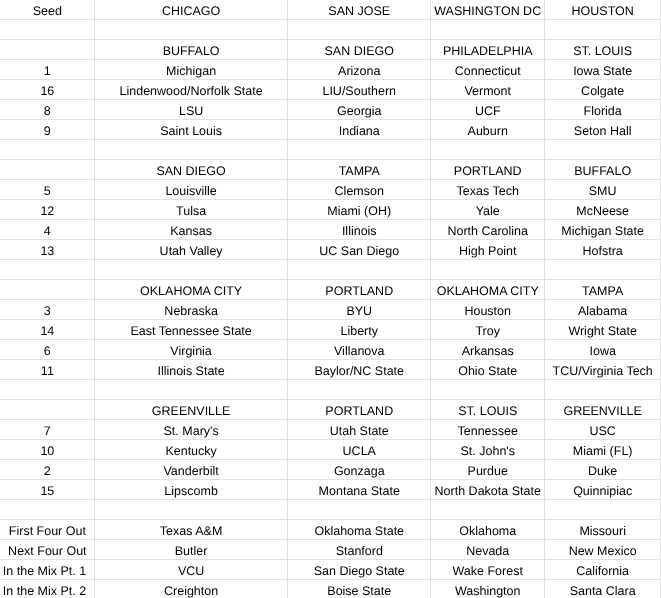
Moving In: TCU, Virginia Tech
Moving Out: Butler, Oklahoma State
Bids by Conference:
Big 10: 10
ACC: 9
Big 12: 9
SEC: 9
Big East: 4
West Coast: 2
Men’s Bracketology 12/29/2025
It’s been a pretty sleepy few days on the bracketology front with most teams off for Christmas. I only have minor updates today, mostly amongst the AQ teams. Conference play starts in earnest tomorrow, so expect some shakeups in my next update.
1: Michigan, Arizona, Connecticut, Iowa State
2: Gonzaga, Vanderbilt, Duke, Houston
3: Purdue, Michigan State, BYU, Kansas
4: Alabama, Illinois, Nebraska, North Carolina
5: Louisville, Texas Tech, USC, Iowa
6: Virginia, Arkansas, Tennessee, St. Mary’s
7: Utah State, Villanova, LSU, Auburn
8: Florida, Georgia, Saint Louis, Clemson
9: SMU, St. John’s, Seton Hall, Kentucky
10: UCF, Baylor, Miami (FL), UCLA
11: Indiana, (NC State/Ohio State), (Butler/Oklahoma State), Yale
12: Akron, Belmont, McNeese, Tulsa
13: Utah Valley, High Point, UC San Diego, Liberty
14: William & Mary, Lipscomb, Arkansas State, Oakland
15: Mercer, Siena, St. Thomas, Northern Colorado
16: Vermont, Colgate, (Southern/Norfolk State), (Lindenwood/LIU)
First Four Out: California, Oklahoma, Boise State, New Mexico
Next Four Out: Wake Forest, Texas, Virginia Tech, Stanford
Moving In: None
Moving Out: None
Bids by Conference:
Big 10: 10
SEC: 9
Big 12: 9
ACC: 8
Big East: 5
West Coast: 2
Men’s Bracketology 12/22/2025
The biggest change in this week’s bracket is Duke moving down to a 2 seed after their loss to Texas Tech. UConn takes their place on the 1 line after a week with two more solid wins.
On the bubble, Arizona State fell out of the bracket, and out of consideration entirely, after a disastrous home loss to Oregon State.
My next update will come a few days after Christmas.
1: Michigan, Arizona, Connecticut, Iowa State
2: Gonzaga, Vanderbilt, Duke, Houston
3: Purdue, Michigan State, BYU, Kansas
4: Alabama, Nebraska, North Carolina, Louisville
5: Illinois, Texas Tech, USC, Iowa
6: Virginia, Arkansas, Tennessee, Utah State
7: LSU, Auburn, Seton Hall, St. Mary’s
8: Florida, Georgia, Saint Louis, Villanova
9: Clemson, SMU, St. John’s, Kentucky
10: UCF, Baylor, Miami (FL), UCLA
11: Indiana, (NC State/Ohio State), (Butler/Oklahoma State), Yale
12: Akron, Belmont, McNeese, Tulsa
13: Utah Valley, High Point, UC San Diego, UNC Wilmington
14: Sam Houston State, Lipscomb, Wright State, Arkansas State
15: Mercer, Siena, North Dakota State, Northern Colorado
16: Vermont, Colgate, (Southern/Norfolk State), (Lindenwood/LIU)
First Four Out: California, Oklahoma, Boise State, New Mexico
Next Four Out: Missouri, Wake Forest, Texas, Virginia Tech
Moving In: UCF, Butler
Moving Out: Oklahoma, Arizona State
Bids by Conference:
Big 10: 10
SEC: 9
Big 12: 9
ACC: 8
Big East: 5
West Coast: 2
Men’s Bracketology 12/15/2025
A fun weekend for college hoops led to a bunch of changes in today’s bracket. Arizona’s spot on the 1 line was further secured with a big win over Alabama. LSU continued a surprising start to the season with a win over SMU, moving safely into the field. Kentucky also picked up their first win of note against Indiana.
I’ll be back with my next update next Monday- the next few days are pretty light on meaningful games before a busy Saturday in college hoops.
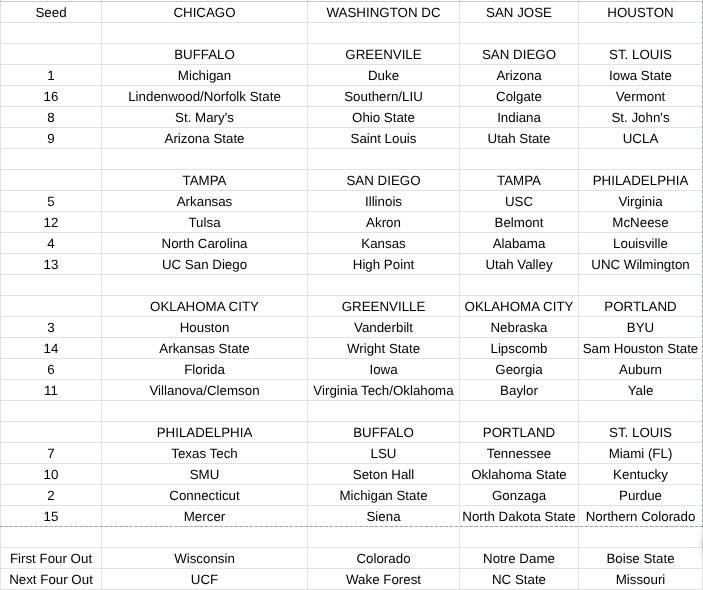
Moving In: Oklahoma, Arizona State, Villanova
Moving Out: UCF, Colorado, NC State
Bids by Conference:
Big 10: 10
SEC: 10
Big 12: 9
ACC: 8
Big East: 4
West Coast: 2
Men’s Bracketology 12/12/2025
The resumes at the top of the seed list are stronger than I’m used to for this time of year. The biggest factor is that top teams are scheduling each other more often than ever before in non-conference play- so teams like Michigan and Duke have stacked up 4 or 5 really excellent wins already.
I know I mentioned it last post, but it bears repeating how bad the situation is for the Big East. The league is 6-26 in Q1 + Q2 games if you take away UConn. St. John’s predictive metrics are good enough that I expect them to right the ship, and I gave Seton Hall one of my last at-large spots today. But the bottom of the league (DePaul, Marquette, Xavier, Georgetown, Providence) is really, really bad. That’s going to drag the rest of the league down.
1: Michigan, Duke, Iowa State, Arizona
2: Connecticut, Gonzaga, Purdue, Vanderbilt
3: Michigan State, Houston, BYU, Alabama
4: Illinois, Louisville, Kansas, North Carolina
5: Nebraska, Virginia, Iowa, USC
6: Arkansas, Auburn, Tennessee, Georgia
7: St. Mary’s, Texas Tech, Florida, Indiana
8: St. John’s, SMU, Oklahoma State, Baylor
9: Miami (FL), LSU, Utah State, UCLA
10: Clemson, Seton Hall, Saint Louis, Colorado
11: NC State, (Ohio State/Kentucky), (UCF/Virginia Tech), Yale
12: Akron, Belmont, McNeese, Tulsa
13: Utah Valley, High Point, UC San Diego, UNC Wilmington
14: East Tennessee State, Sam Houston State, Lipscomb, Wright State
15: Arkansas State, Siena, North Dakota State, Northern Colorado
16: Vermont, Colgate, (Southern/Norfolk State), (UT Martin/LIU)
First Four Out: Santa Clara, Notre Dame, Arizona State, Syracuse
Next Four Out: Villanova, Washington, Oklahoma, Butler
Also Considered: Wisconsin, California, Wake Forest, Creighton, Texas, Missouri, TCU, Texas A&M, St. Bonaventure, Colorado State, San Diego State, VCU, New Mexico, George Mason
Bids by Conference:
Big 10: 10
Big 12: 10
ACC: 9
SEC: 9
Big East: 3
West Coast: 2
Men’s Bracketology 12/1/2025
It’s been a fun first month of the season. I’ve been especially enjoying it as a Michigan State fan, as we own double digit wins over Kentucky and North Carolina on neutral courts.
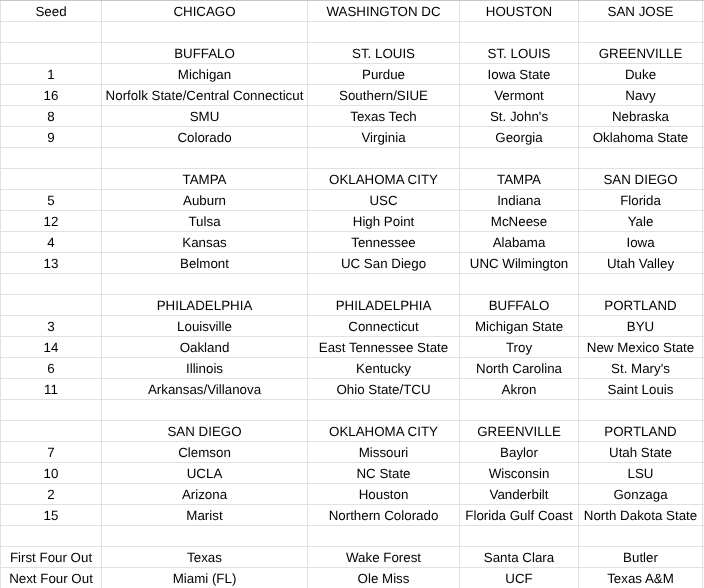
Nationally, the biggest story to me has been the demise of the Big East. A lot of people were hypothesizing that the Big East was well positioned for the revenue share era as those teams don’t have to split funds with their football programs. UConn looks solid, but St. John’s has had a rough start to the season, and the rest of the league looks awful. I have Villanova just barely in the field, and Butler in the conversation, but it’s crazy that the league has so many bad teams.
I’ll be back with another update in two weeks or so.
Bids by Conference:
Big Ten: 11
Big 12: 10
SEC: 10
ACC: 7
Big East: 3
West Coast: 2
Also Considered: Oklahoma, Northwestern, Creighton, Seton Hall, California, Arizona State, VCU, San Diego State, Kansas State, Washington, George Mason, Notre Dame, Syracuse, George Washington, West Virginia
Preseason Men’s Bracketology 2025-26
Welcome back to college basketball season! I’m mainly focused on college football for the next two months, but I’ll update my basketball bracketology periodicially over that time- expect another update after Feast Week.
I have some exciting changes planned for my bracketology this year. I hope to bring you a more mathematically rigorous and data-driven approach to bracketology this year. Details to come in a few months- I plan on working on this project over Christmas.
Enjoy the first few weeks of the season!

1: Houston, Duke, Florida, Purdue
2: Illinois, Michigan, Kentucky, Connecticut
3: UCLA, BYU, St. John’s, Tennessee
4: Louisville, Texas Tech, Gonzaga, Arizona
5: Iowa State, Arkansas, Alabama, Kansas
6: Ohio State, Vanderbilt, Michigan State, Wisconsin
7: Auburn, North Carolina, NC State, Oregon
8: Baylor, Ole Miss, USC, Creighton
9: Missouri, Oklahoma, Georgia, Virginia
10: Texas, Mississippi State, San Diego State, Clemson
11: (Maryland/Texas A&M), (Cincinnati/Utah State), Memphis, Saint Louis
12: Belmont, Liberty, Yale, Hawai’i
13: Chattanooga, Utah Valley, Charleston, James Madison
14: Akron, High Point, Portland State, McNeese
15: Youngstown State, South Dakota State, Siena, Florida Gulf Coast
16: Little Rock, Colgate, (Vermont/Southern), (Norfolk State/LIU)
First Four Out: Indiana, Iowa, SMU, Washington
Next Four Out: Marquette, Providence, Nebraska, Boise State
Also Considered: Oklahoma State, VCU, St. Mary’s, West Virginia
Bids by Conference:
SEC: 14
Big Ten: 10
Big 12: 8
ACC: 6
Big East: 3
Mountain West: 2
2025 Bracketology Year in Review
Bracketology is now a numbers game
2025 was not the best year for my bracketology. I selected 66/68 teams correctly and seeded 44 teams correctly for a Paymon score of 350. To an outsider, those may seem like impressive results, but it put me slightly below average amongst bracketologists this year.
I started publishing my bracketology in 2011 back on my old blog. Over my 15 year run as a bracketologist, lots of things have changed. The NET replaced the RPI, quads were introduced and predictive metrics became part of the selection criteria. While you can quibble with some details of the new way of doing things, it is inarguably better than the old way. I’m not even going to try to convince you of this- I can’t imagine any sane college basketball fan would want to go back to the RPI.
There were a few new changes to selection criteria for the 2025 season. T-Rank and WAB were added as official selection criteria. This means that there are now 6 metrics on each team’s resume- the 3 “resume metrics” (KPI, SOR and WAB) and the 3 “predictive metrics” (KenPom, BPI and T-Rank). This is simply a continuation of a decade-long trend of making the selection process increasingly quantifiable.
The genesis for this article was this tweet by Kerry Miller.

I was amazed that such a crude model would have performed so well. However, I profoundly disagree with his take on this fact. Kerry has been doing bracketology for even longer than I have and is one of the people in the community I have a lot of respect for.
I think it’s a good thing, not a bad thing, that the committee is moving to a more numbers-based approach. It’s kind of silly to me that the tournament is selected by a group of humans full of conflicts of interests, as this year’s drama surrounding North Carolina AD Bubba Cunningham showed. If I ruled the world, the tournament would be selected entirely by WAB, which Seth Burn lays out a great case for here. The more meritocratic and the less full of human meddling we can get the system, the better.
I also think it was foreseeable that we are moving in this direction. This is the exact rationale I applied behind putting North Carolina into my final bracket projection of the year, which was quite an unpopular opinion at the time. The metrics said that they should get in and the committee is much more metrics-driven than before.
The natural follow-up is to try to model this change in committee behavior to understand how to improve my bracketology going forwards. I’ll take a stab at that below.
Performance of our crude model
Suppose, as mentioned above, we created a crude model which is just the average of all six metrics and used that to seed and select the teams. Let’s get into the details of how such a model would have performed. In the screenshots below, the “actual rank” column is a team’s placement on the selection committee’s seed list, and the “predicted rank” column is a team’s placement under our model.
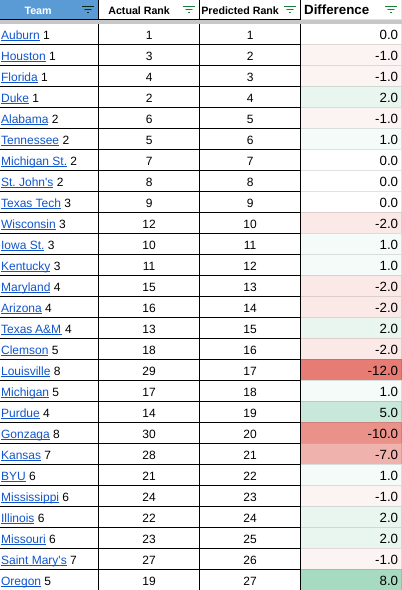


As you can see, this model would have gotten 66/68 teams correct- it would have had West Virginia and Ohio State in the field as opposed to Texas and San Diego State. However, it performed much better than my own bracketology in terms of seeding, seeding 53 teams correct as opposed to 44. (Note that these results are actually slightly better than what Kerry said they’d be).
This is a pretty good performance. It does quite well across all parts of the seed list. If you score it based on seed and not position on the seed list (as is customary), it is nearly perfect on the top 4 seed lines (switching only Purdue and Clemson), decent in the middle, and perfect on the bottom 4 seed lines.
However, it is easy to spot some patterns here. If you look at the teams that the model underseeds (Memphis, Oregon, Drake etc.) they generally have better resume metrics than predictive metrics. If you look at the teams that the model overseeds (Gonzaga, VCU, North Carolina etc.) they generally have better predictive metrics than resume metrics. Here are the teams who have much better predictive metrics than resume metrics:

You can see that our model is too high on almost all of these teams, most notably Gonzaga.
Now let’s look at the teams that have much better resume metrics than predictive metrics:

Our model is too low on nearly all of these teams. The notable exception is Louisville. They are the true outlier of the year to me- I have no idea how the committee decided they were an 8 seed.
My bracketology philosophy going forward
I think that I, along with other bracketologists, have made bracketology too complicated of a problem. There is so much analysis and over-analysis about lots of different factors, when we have every indication that the committee is getting more mathematical and streamlined in their decision making.
Going forward, the starting point for my bracketology is going to be ranking the teams by the average of their six metrics. I will then bump up the teams with relatively strong resume metrics and bump down the teams with relatively weak resume metrics. This is going to form the backbone of my bracketology, and I will make relatively few deviations from it. Some reasons for deviations I will make include:
Injuries. The committee’s shocking decision to leave West Virginia out shows that this can still matter.
Extreme values in other key bracketology data. I will define these as Q1 wins and NCSOS. These numbers do have some explanatory power (albeit less than others seem to think) and if a team has abnormally good or bad results in them (e.g. North Carolina) I will move them a few spots accordingly.
Ignoring the end of Champ Week. We have a lot of data (2025 Michigan, 2022 Texas A&M etc.) that the committee largely finalizes the seed list on Friday of conference tournaments and does not consider data beyond that. I will probably not move my seed list based on any results on the final Saturday or Sunday of conference tournament play.
I am excited that bracketology has become a more quantitative process over the years. My aim is to lean into that and adopt a more quantitative approach myself with the goal of improving my bracketology going forwards.
2025 Bracket Picking Guide
General Guidelines
Every year the internet is awash with articles describing how to pick the perfect March Madness bracket. Most of these articles will discuss some trends of past champions. For example, you’ll hear a lot of people say this year not to pick Auburn because they’ve lost 3 of their last 4 games.
I think that these articles are largely useless because they fundamentally misunderstand the goal of filling out a bracket. Your goal in filling out a bracket is not to predict what is going to happen, but rather to maximize your chances of winning your bracket pool. If you wanted to maximize the expected score of your bracket, you would just pick the Vegas favorite to win every single game and you would end up with a bracket comfortably around 70th percentile.
That sort of strategy will guarantee that you don’t come in last, but it also guarantees you won’t come in first. To maximize your chances of coming in first in your bracket pool, you need to know the answers to the following two questions:
-How big is your bracket pool?
As a general rule of thumb, if you are trying to win an n person pool, you need to finish with a bracket that is in the top 1/n of brackets. To put that in other terms, if you are trying to win a 10,000 person pool, you have to finish in the top 0.01% of brackets. If you are trying to win a 5 person pool, you only have to finish in the top 20% of brackets. If you want to win a big pool you need to shoot for the moon. If you want to win a small pool you can be much more conservative.
-Who is everyone else picking?
Filling out a bracket is all about finding value. As I’ll explain below, with limited exceptions, you only have a realistic shot of winning your pool if you select the correct champion. Let’s use Duke as an example. The Blue Devils have around a 20% chance of winning the national title. If they’re being picked in 80% of brackets, there’s no point in picking Duke- you will need to nail the rest of your bracket to beat out the scores of others who picked them. If they’re only being picked in 5% of brackets, they’re a great pick- you have a ⅕ chance of getting the national champion correct and only have to beat out a few other people who picked them.
Bracket Scoring
The rest of this post assumes that you are using a standard bracket scoring system. The standard scoring system gives 10 points for a correct first round selection, 20 points for a correct second round selection, and 40, 80, 160 and 320 points for the subsequent rounds. ESPN, CBS and Yahoo all use this system. In practice, what this means is that almost every bracket with the correct champion will finish ahead of almost every bracket with an incorrect champion.
In medium to large formats, the ideal strategy is to pick an unconventional (but underpicked) champion and then go with largely safe picks elsewhere. This allows you to both capture the value in an underpicked team and also puts you in a good position to beat out anyone else who picked the same team. Feel free to pick early round upsets as well- if you want to pick some random 15 seed for fun, it’s only 10 points and it’s very unlikely to move the needle when compared to the 320 points you get for selecting the right champion.
Who to pick this year?
We’ve now established that your primary goal should be to pick a team as your champion whose true odds of winning the tournament are greater than the rate at which they’re being selected to win the tournament. How do we go about estimating these two quantities?
To estimate each team’s odds of winning the tournament, I used betting markets to estimate each team’s chances. For the men’s tournament I also present a team’s chances as calculated as an average of 3 computer models (those models being Ken Pomeroy’s, Bart Torvik’s and Kelley Ford’s), if you prefer to use that instead.
I found data from ESPN and Yahoo as to who the public is picking in their brackets and used that for the second half of the equation.
The “Edge” column below is simply calculated as the % of public picks minus the betting market implied probability.

So who should you pick as your champion this year? There are lots of good options. If you’re trying to win a small pool (up to 30 people), I like going with Auburn or Houston. It’s rare to see the #1 overall seed be underpicked, but the Tigers faltered down the stretch and I think that scared too many people off. Houston is a better choice if you are going by the computer average, but this is bolstered by Torvik being unusually high on them. The Cougars have also been better liked by computers than betting markets for a few years in a row now.
If you are trying to win a medium-sized pool (30-100 people) you might want to go a bit further afield. Texas Tech, Iowa State, Maryland and Arizona are all intriguing options. If you are trying to win a large pool (100+ people), Gonzaga is a good option.
I know a lot of people (myself included) like to join extremely large (10,000 people or so) pools that often are free to enter and have cash prizes. St. Mary’s and Missouri look like the best picks in those formats.

In the women’s tournament this year, there are two clear frontrunners in South Carolina and UConn, and then a clear next tier of 4. There are plenty of reasonable picks here- I think I will probably go with Texas or Notre Dame. If you’re trying to win a bigger women’s pool this year, Kansas State is a great pick.
Lastly, I’ll look at each region in the tournament to identify some good Final Four picks. I generally like to make Final Four picks that are a bit more conventional than my champion pick.
Men’s Regions

Auburn is a very reasonable pick. If you want to pick someone else, Michigan State does not present much value, but plenty of other teams in this region do- I particularly like Iowa State.

Duke is pretty strongly overpicked. If you want to pick chalk because you’re picking a crazy national champion, I get that. However, if you want to pick a dark horse to make the Final Four, this is a good region to do it. Arizona and BYU both catch my eye.

Houston is a very reasonable pick. They had the misfortune of drawing a likely matchup with 8 seed Gonzaga in the second round, who is in the top 10 in all of the computers. I like the Zags as a sleeper pick, along with Illinois.

Again, I couldn’t fault you for taking Florida who is a coin flip to make the Final Four. I could fault you for taking St. John’s, who is being picked at several times the rate of Texas Tech and Maryland despite having similar odds of making the Final Four.
Women’s Regions

Generally you’re best off picking mostly chalk in the women’s bracket, but this wouldn’t be a bad region to pick an upset. UCLA has some real competition here, I think I will pick NC State here.

South Carolina is slightly overpicked but there’s no clear second contender here. I think I will likely go with them anyways just for lack of a better option.

If you follow my advice from earlier, you’ve probably picked either Texas or Notre Dame as your national champion already so you know who you’re picking to make the Final Four from this region. Notre Dame was inexplicably given a 3 seed by the committee despite being a top 6 team all season.

2 seed UConn will be significantly favored over 1 seed USC in a hypothetical Elite Eight matchup and that makes them an easy pick from this region, considering that they’re being picked at the same rate.
Good luck with your brackets this year!