2026 Bracket Picking Guide
General Guidelines
Every year the internet is awash with articles describing how to pick the perfect March Madness bracket. Most of these articles will discuss some trends of past champions. For example, you’ll hear a lot of people say things like “don’t pick a team with a freshman point guard” or “Gonzaga never wins in the tournament”.
I think that these articles are largely useless because they fundamentally misunderstand the goal of filling out a bracket. Your goal in filling out a bracket is not to predict what is going to happen, but rather to maximize your chances of winning your bracket pool. If you wanted to maximize the expected score of your bracket, you would just pick the Vegas favorite to win every single game and you would end up with a bracket comfortably around 70th percentile.
That sort of strategy will guarantee that you don’t come in last, but it also guarantees you won’t come in first. To maximize your chances of coming in first in your bracket pool, you need to know the answers to the following two questions:
-How big is your bracket pool?
As a general rule of thumb, if you are trying to win an n person pool, you need to finish with a bracket that is in the top 1/n of brackets. To put that in other terms, if you are trying to win a 10,000 person pool, you have to finish in the top 0.01% of brackets. If you are trying to win a 5 person pool, you only have to finish in the top 20% of brackets. If you want to win a big pool you need to shoot for the moon. If you want to win a small pool you can be much more conservative.
-Who is everyone else picking?
Filling out a bracket is all about finding value. As I’ll explain below, with limited exceptions, you only have a realistic shot of winning your pool if you select the correct champion. Let’s use Duke as an example. The Blue Devils have around a 20% chance of winning the national title. If they’re being picked in 80% of brackets, there’s no point in picking Duke- you will need to nail the rest of your bracket to beat out the scores of others who picked them. If they’re only being picked in 5% of brackets, they’re a great pick- you have a ⅕ chance of getting the national champion correct and only have to beat out a few other people who picked them.
Bracket Scoring
The rest of this post assumes that you are using a standard bracket scoring system. The standard scoring system gives 10 points for a correct first round selection, 20 points for a correct second round selection, and 40, 80, 160 and 320 points for the subsequent rounds. ESPN, CBS and Yahoo all use this system. In practice, what this means is that almost every bracket with the correct champion will finish ahead of almost every bracket with an incorrect champion.
In medium to large formats, the ideal strategy is to pick an unconventional (but underpicked) champion and then go with largely safe picks elsewhere. This allows you to both capture the value in an underpicked team and also puts you in a good position to beat out anyone else who picked the same team. Feel free to pick early round upsets as well- if you want to pick some random 15 seed for fun, it’s only 10 points and it’s very unlikely to move the needle when compared to the 320 points you get for selecting the right champion.
Who to Pick this Year?
We’ve now established that your primary goal should be to pick a team as your champion whose true odds of winning the tournament are greater than the rate at which they’re being selected to win the tournament. How do we go about estimating these two quantities?
To estimate each team’s odds of winning the tournament, I used betting markets to estimate each team’s chances. For the men’s tournament I also present a team’s chances as calculated as an average of 2 computer models (those models being Bart Torvik’s and Evan Miya’s), if you prefer to use that instead.
I found data from ESPN and Yahoo as to who the public is picking in their brackets and used that for the second half of the equation.
The “Edge” column below is simply calculated as the % of public picks minus an average of the betting market implied probability and the computer models.
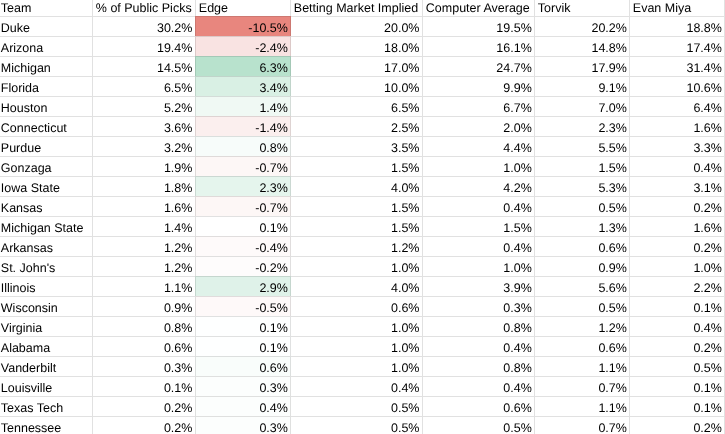
So who should you pick as your champion? It’s easier to answer “who should you not pick”, and the answer to that is Duke. The Blue Devils are pretty over-picked, as the #1 overall seed often is- 30% of people are picking them to win their brackets.
In a normal size pool, Michigan, Florida and Houston are all reasonable options. All three teams are slightly under picked. Once your pool gets a bit bigger (e.g. 30-100 people) you might want to look further afield at teams like Iowa State or Illinois.
If you’re looking at a really big pool (a few hundred or more), Vanderbilt and Tennessee are reasonable options.
An important caveat is to keep in mind who is in your pool and what they might do. For example, if you live in Chicago and are filling out a bracket for your work pool, you might want to avoid Illinois, because there might be a lot of Illinois fans in your pool who pick them.
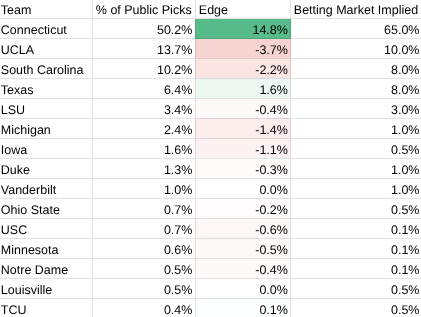
On the women’s side it’s pretty simple- you should pick UConn. The Huskies are picked in half of brackets, but have a 2/3 chance of winning the national championship. They are undefeated and none of their games have been particularly close- the computer models are also in agreement that they’re leaps and bounds ahead of the rest of the country.
The interesting thing in the women’s bracket this year is who you should pick to win the various regions. I’ll get to that in the next section.
Before we divide into the individual regions, it’s worth noting that on the men’s side I generally like to make Final Four picks that are a bit more conventional than my champion pick. On the women’s side, you might want to take a chance somewhere to differentiate yourself from the people who pick all 1 seeds to make the Final Four.
Men’s Regions

Duke is over-picked but it’s a bit difficult to work out who to pick instead, as Connecticut and Michigan State are weaker 2 and 3 seeds. I might just play it safe and roll with Duke.

There’s some value on both Purdue and Gonzaga here. Arkansas and Wisconsin both have a lot of upside for a 4 and 5 seed respectively as well.

If we just go off the betting markets, there’s a ton of edge on Iowa State. If you’re not picking Michigan to win it all, the Cyclones could be a good Final Four pick.

There’s a good amount of value on Illinois. Florida is also a lot less picked than the other 1 seeds, but this is pretty fair as they have the lowest odds to make the Final Four of any 1 seed. Houston is surprisingly quite over picked for the first time in a few years.
Women’s Regions
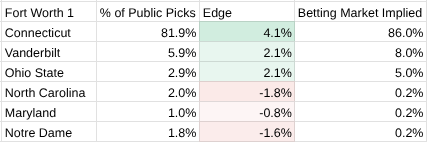
Just pick UConn here and move on with the rest of your bracket.
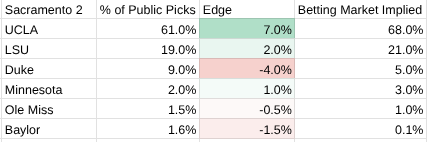
You probably want to pick against one of the 1 seeds somewhere, as you need to differentiate yourself from the consensus bracket somehow. This could be a good place to do it, as LSU has the best chance at the Final Four of any of the non-1 seeds in the tournament.
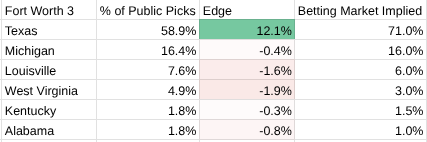
People are getting a bit too fancy here betting against Texas. The Longhorns are one of the best teams in the country. I could potentially entertain picking Michigan here as well.
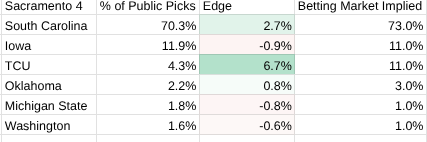
South Carolina is quite likely to advance out of this region. You could potentially pick TCU here, and pair them with the 3 1 seeds in the other regions in your Final Four- that could give you an intriguing path to victory.